When Surrender Doesn’t Silence the Mind: Learning to Trust God in the Middle of the Storm
When Surrender Doesn’t Silence the Mind: Learning to Trust God in the Middle of the Storm
By Maria Castañeda | Faith 2B Strong OnPurpose™
There are seasons in life when you want nothing more than to trust God completely, yet your mind keeps returning to the very circumstances you have already placed in His hands.
You pray. You cry. You surrender. You worship. You remind yourself of His promises. You tell your soul to be still and your heart to trust Him.
And then, somehow, the thoughts return.
What will happen tomorrow? Where will I be? How will I pay my bills? What if the provision doesn’t come? What if I cannot keep the promises I made? What if the circumstances become worse before they get better?
And suddenly, you find yourself questioning not only your circumstances but also your relationship with God.
Am I praying the wrong way? Is my faith not strong enough? Have I failed to surrender completely? Is God not answering because there is still too much of me in the way?
These are the questions that have been moving through my heart.
And perhaps I am not the only one who has experienced this quiet battle between what the spirit believes and what the mind keeps trying to understand.
When You Begin to Question Your Own Surrender
I have been thinking about my circumstances more than I want to admit.
I want to trust God. I want to rest in His promises. I want to live by faith and not by sight. Yet my mind keeps running ahead of me, trying to figure out tomorrow before I have finished living today.
I think about shelter. I think about finances. I think about the responsibilities waiting for me. I think about the things I cannot afford to lose and the promises I desperately want to keep.
And somewhere in the middle of all these thoughts, I begin to feel guilty.
I tell myself that perhaps I am too focused on my circumstances. Maybe I am holding on too tightly. Perhaps I have not surrendered enough. Maybe there is something within me that I still need to release before I can experience the peace I keep asking God to give me.
But the more I examine myself, the more exhausted I become.
I begin to treat surrender as something I must perform perfectly. I start looking for the correct words, the correct posture, the correct spiritual condition that will finally make my mind quiet.
And without realizing it, I turn my desire to trust God into another burden I must carry.
But is that what the Father asks of me?
Does He require me to become perfectly peaceful before I can come to Him?
Does He wait for me to overcome every fear before He listens to my prayers?
Scripture reminds me otherwise:
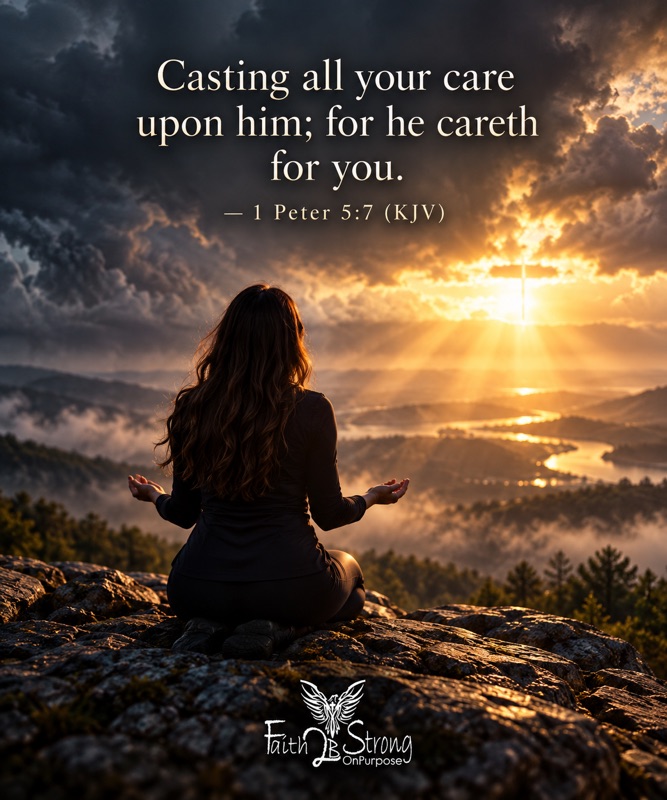
“Casting all your care upon him; for he careth for you.”
— 1 Peter 5:7, KJV
The Word does not tell me to cast my cares upon Him only after I have conquered them. It tells me to bring them to Him because He cares for me.
Perhaps the beginning of deeper surrender is not learning how to hide my struggle from God, but learning how to bring my struggle honestly into His presence.
I Want to Trust God, but I Am Still Human
There are moments when I wish I could escape the constant movement of my own mind.
I wish I could stop thinking about what happened yesterday and what might happen tomorrow. I wish the memories would lose their ability to disturb my peace. I wish I could stop feeling fear when I cannot see the outcome.
Sometimes I become so tired of being human that I want to be nothing more than a spirit resting completely in God’s presence, untouched by the uncertainties of this world.
But I am learning that God did not ask me to stop being human in order to walk with Him.
Jesus Himself experienced sorrow and anguish.
In the garden of Gethsemane, He said:
“My soul is exceeding sorrowful, even unto death.”
— Matthew 26:38, KJV
Jesus did not pretend that the anguish was absent. He brought it before the Father.
Then He prayed:
“Nevertheless not as I will, but as thou wilt.”
— Matthew 26:39, KJV
His surrender did not mean that the anguish was imaginary. His obedience did not require Him to deny what He was experiencing.
And perhaps this is something I need to understand more deeply: surrender is not the absence of emotion. It is the decision to bring every emotion under the care and authority of God.
I can be afraid and still trust Him.
I can cry and still believe His Word.
I can feel overwhelmed and still choose obedience.
I can acknowledge that I do not understand what God is doing without concluding that He has abandoned me.
My humanity does not disqualify me from depending on Him.
When the Past Tries to Explain the Present
Another battle begins when my mind starts searching through the past.
I revisit old conversations. I remember painful words. I think about decisions I made, things I lost, and moments I wish I could change.
Sometimes I wonder whether the words spoken over me by someone else have somehow shaped the circumstances I am experiencing today.
I ask myself, Was it this? Was it that? Is there something from my past that I failed to surrender? Is that why I cannot seem to move forward?
And the questions continue.
But I am learning that not every painful circumstance needs to be explained by a painful memory.
Not every difficulty is proof of a spiritual curse.
Not every recurring thought is a message about my future.
I do not have to spend my life investigating every wound to discover why something difficult is happening today.
God’s Word reminds me:
“There is therefore now no condemnation to them which are in Christ Jesus.”
— Romans 8:1, KJV
I cannot change yesterday, but I can choose what I allow to govern my heart today.
I can acknowledge that certain words hurt me without allowing those words to define my identity. I can recognize that my past affected me without making my past the authority over my future.
I can place those memories before God again without accusing myself of having failed the first time I surrendered them.
Sometimes healing means remembering something without allowing it to determine what I believe about myself.
Sometimes freedom begins when I stop asking, What did I do wrong? and begin asking, What is the next faithful step I can take?
The Battle Between Today and Tomorrow
Perhaps one of the hardest lessons I am learning is how to live in today when tomorrow feels uncertain.
It is difficult to focus on the present when the questions about the future seem urgent.
How will I provide for myself? Where will I live? Will I have enough? What happens if the door I am knocking on remains closed?
I want answers. I want a plan. I want to know that everything will work out.
But faith often requires me to walk without having all the answers.
Jesus said:
“Take therefore no thought for the morrow: for the morrow shall take thought for the things of itself.”
— Matthew 6:34, KJV
I am learning that this does not mean I should ignore my responsibilities or refuse to plan. It means I do not have to mentally live through every possible disaster before it happens.
There is a difference between preparing for tomorrow and suffering through tomorrow before it arrives.
I can make the phone call I need to make today.
I can take the responsible step that is available to me today.
I can acknowledge the bills that need attention without allowing them to consume every moment of my life.
I can do what is within my reach and recognize that there are outcomes I cannot control.
Tomorrow may require another decision, another prayer, another step of courage. But I do not have to carry all of tomorrow’s weight in today’s heart.
God has given me grace for this moment, and I can ask Him for wisdom for the next one.
When You Mistake Fear for a Lack of Faith
I think one of the most painful things we can do to ourselves is to condemn ourselves for struggling while we are already struggling.
We experience fear, then feel guilty for being afraid.
We experience sadness, then wonder whether we have lost our faith.
We pray for peace, and when the anxious thoughts return, we conclude that our prayers were somehow insufficient.
But the presence of fear does not automatically mean the absence of faith.
In Mark 9:24, a father brought his need to Jesus and cried:
“Lord, I believe; help thou mine unbelief.”
— Mark 9:24, KJV
What moves me about this passage is the honesty of the man’s prayer.
He did not pretend that his belief was perfect. He did not hide the part of himself that was struggling. He brought both his faith and his weakness to Jesus.
And that is a prayer I can pray, too.
Lord, I believe You. Help me where I struggle to believe.
Lord, I want to trust You. Help me when fear becomes louder than Your promises.
Lord, I want to surrender. Help me when my hands keep reaching for the things I cannot control.
I do not need to pretend that my faith is stronger than it feels. I need to keep bringing my faith, however small it feels, to the One in whom I have placed it.
Surrender Is Not a Performance
I am beginning to understand that surrender is not a spiritual performance in which I must demonstrate that I have achieved perfect peace.
It is not forcing myself to stop thinking.
It is not denying my emotions.
It is not pretending that my circumstances do not hurt.
And it is not repeatedly examining myself until I discover some hidden reason God might be withholding His help.
Surrender is learning to acknowledge what is real without allowing it to become greater than the truth of who God is.
It is saying, “Father, this situation frightens me, but I will bring my fear to You.”
It is saying, “I do not know how this will work out, but I will take the next responsible step.”
It is saying, “I remember what happened, but I refuse to let the past dictate every conclusion I draw about my future.”
It is saying, “I cannot control the outcome, and I need Your wisdom to do what I can.”
And when the same fear returns tomorrow, surrender may mean bringing it to God again.
Not because yesterday’s surrender was false, but because I am still learning to live in dependence on Him.
The apostle Paul wrote:
“And he said unto me, My grace is sufficient for thee: for my strength is made perfect in weakness.”
— 2 Corinthians 12:9, KJV
His grace is not reserved for the version of me who never struggles.
His grace meets me in my weakness.
I Am Learning to Pray Differently
Maybe I do not need to find more impressive words.
Maybe I need to stop trying to make my prayers sound like those of someone who has already overcome everything.
Maybe I can come to God as I am.
“Father, I am tired.”
“Father, I am afraid.”
“Father, I don’t understand.”
“Father, I keep thinking about tomorrow, and I need help returning to today.”
“Father, I have surrendered this before, but the memory still hurts. Teach me how to live in Your truth when it returns.”
“Father, I don’t know what to do next. Give me wisdom.”
These are not the prayers of someone who has abandoned faith.
They are honest prayers from someone who knows where to turn.
Psalm 62:8 says:
“Trust in him at all times; ye people, pour out your heart before him: God is a refuge for us.”
Pour out your heart.
Not the heart you think you should have.
Not the heart that has already conquered every fear.
Your heart.
And then remain willing to receive His help through His Word, through wise decisions, through people who care, and through the practical opportunities available to you.
Trusting God does not mean refusing human help. It does not mean ignoring financial responsibilities or pretending that housing concerns are insignificant. Faith and responsible action can walk together.
I can pray for provision and still make a phone call.
I can trust God and still ask for help.
I can surrender the outcome while taking responsibility for the next step.
A Prayer for the Woman Who Is Tired of Fighting Her Own Mind
Father, in the name of Jesus, I come before You without pretending to be stronger than I am. You know the thoughts that overwhelm me, the memories that return, the fears I struggle to silence, and the uncertainty I carry about tomorrow. I have tried so hard to surrender everything, yet sometimes I find myself questioning whether I have done enough. Teach me to stop measuring Your faithfulness by how peaceful I feel. Help me remember that I can bring You my weakness without shame. Heal the wounds of my past, guard my heart from lies, and teach me to recognize the difference between what is true and what fear tells me might happen. Give me wisdom for today’s responsibilities and grace for what I cannot resolve yet. When I begin to run ahead into tomorrow, gently bring my attention back to You and the step I can take today. Help me trust Your Word without denying my humanity. I surrender my fears, my memories, my expectations, and my need to understand everything. I am Yours, even when I am tired, even when I am afraid, even when I have more questions than answers. In Jesus’ name, amen.
I Do Not Have to Have It All Figured Out to Keep Walking
I am still learning.
I am learning that faith does not require me to become emotionless.
I am learning that a returning thought does not mean my surrender was meaningless.
I am learning that the past can hurt without owning my future.
I am learning that planning for tomorrow is different from allowing tomorrow to steal today’s peace.
And I am learning that God does not ask me to earn His attention by praying perfectly.
I may not have every answer today. I may still feel afraid. I may still need to remind myself of His promises more than once.
But I can return to His Word.
I can ask for help.
I can take the next step.
And I can keep coming to Him honestly.
Perhaps the freedom I have been seeking is not the ability to control every thought or eliminate every feeling. Perhaps it is learning that I do not have to obey every thought, believe every fear, or solve every uncertainty before I can rest in God’s care.
I am human, and I am still learning how to trust Him.
That does not mean I have failed.
It means I am still walking.
And today, by His grace, I will take the next step.
— Maria Castañeda
Faith 2B Strong OnPurpose™ | Faith. Strength. Purpose.


Comments
Post a Comment